

Acupuncture Treatment Guidelines & FAQ
If you are new to acupuncture, the following guidelines explain how to prepare for your appointment, what to expect during treatment, and how to care for yourself afterward. We primarily provide in-home acupuncture in Wesley Chapel, Land O’ Lakes, Lutz, New Tampa, Zephyrhills, and nearby communities. Limited appointments are available at our Wesley Chapel treatment location upon request.
I. Before, During, and After Your Acupuncture Treatment
A. Before Treatment
1. Please tell your acupuncturist before treatment if any of the following apply to you:
You have a serious cardiovascular condition, an irregular heartbeat, a pacemaker or other implanted electrical device, or a history of heart attack.
You have a bleeding disorder, bruise or bleed easily, have severe anemia, or take blood-thinning or antiplatelet medication.
You have an aneurysm, an arteriovenous malformation, a seizure disorder, or another significant neurological condition.
You have poorly controlled diabetes or high blood pressure, unusually low blood pressure, or a history of fainting.
You are pregnant, think you may be pregnant, or are currently menstruating.
Please wear loose, comfortable clothing that allows easy access to the areas being treated. Avoid one-piece outfits when possible. You may be asked to remove watches, anklets, necklaces, or other jewelry near the treatment area.
Acupuncture should not be performed immediately when you are extremely hungry, overly full, exhausted, severely sleep deprived, highly anxious or emotionally distressed, or immediately after strenuous exercise.
If you are hungry, please have a light snack before treatment. Otherwise, rest quietly for approximately 15 to 20 minutes so your body and mind can settle before treatment. If you have recently experienced significant blood loss, please contact the clinic before your appointment.
B. During Treatment
Relax your entire body and work with your acupuncturist to find a comfortable treatment position.
Depending on your treatment plan, the needles will generally remain in place for approximately 10 to 20 minutes. During this time, please avoid moving or changing position without first telling your acupuncturist. Sudden movement may cause discomfort or injury.
During acupuncture treatment, you may experience sensations such as soreness, numbness, heaviness, fullness or pressure, a mild electric-like feeling, or a sensation that spreads along the pathway of the needle. In Traditional Chinese Medicine (TCM), these are known as Deqi (the characteristic acupuncture sensation) and are considered a normal and beneficial response to treatment. There is no need for concern.
Tell your acupuncturist immediately if you experience dizziness, blurred vision, nausea, heart palpitations, cold sweating, cold hands or feet, shortness of breath, or difficulty breathing. These symptoms may indicate a fainting reaction or another medical concern that requires prompt attention.
C. After Treatment
Do not rub or scratch the needle sites. If a small amount of bleeding occurs, apply gentle pressure with clean cotton or gauze as directed by your acupuncturist.
It is normal to experience mild soreness, numbness, fullness, aching, bruising, minor bleeding, or slight weakness at the treatment site after acupuncture. These reactions generally indicate that the body’s circulation is responding to treatment or that the muscles are relaxing. Most symptoms resolve naturally within a few hours to two or three days.
Take it easy for at least one hour after treatment. Avoid strenuous exercise immediately afterward and follow any additional instructions provided by your acupuncturist.
II. Frequently Asked Questions About Acupuncture
Q1. What should I expect at my first acupuncture appointment?
Your first appointment includes a review of your health history, current symptoms, medications, treatment goals, and any relevant medical concerns. Your acupuncturist will explain the recommended treatment plan and answer your questions before treatment begins.
Q2. How should I prepare for an in-home acupuncture appointment?
Please choose a clean, quiet, and well-lit indoor area with enough space for a portable treatment table and for the acupuncturist to move safely around it. Keep pets in a separate area and minimize interruptions during your treatment.
Wear loose, comfortable clothing and have a light meal within a few hours before your appointment. Avoid being extremely hungry or overly full, and avoid strenuous exercise immediately beforehand.
When scheduling your appointment, please provide any gate codes, parking information, or special entry instructions. Have your current medication and supplement list available, and let your acupuncturist know about any recent changes in your health. We will bring the portable treatment table and necessary treatment supplies.
Q3. How often should I receive acupuncture?
Treatment frequency depends on your condition, symptoms, overall health, response to treatment, and treatment goals. After an evaluation, your acupuncturist will recommend an individualized treatment plan.
Some treatment plans may begin with one to three visits per week and become less frequent as symptoms improve. There is no single schedule that is appropriate for everyone.
Q4. When might acupuncture be appropriate?
Acupuncture has a wide range of indications and offers the advantages of being easy to administer, producing prompt therapeutic effects, and having relatively few side effects. For common conditions that can be treated with acupuncture, please visit our Conditions We Treat page. When acupuncture is combined with Chinese herbal medicine, the therapeutic effects may be further enhanced.
Q5. Can acupuncture needles cause an infection?
Today, most acupuncturists use sterile, single-use needles that are discarded after one treatment. As a result, the risk of infection is very low.
Q6. Can frequent acupuncture damage muscles or nerves?
Licensed acupuncturists complete formal coursework in anatomy and meet applicable licensure examination requirements. They generally do not repeatedly needle the same fixed points over an extended period, the risk of injury to muscles or nerves is very low.
Q7. Are there risks associated with acupuncture?
Overall, acupuncture is considered quite safe. When adverse events occur, they are usually related to improper technique by the practitioner or to individual patient factors.
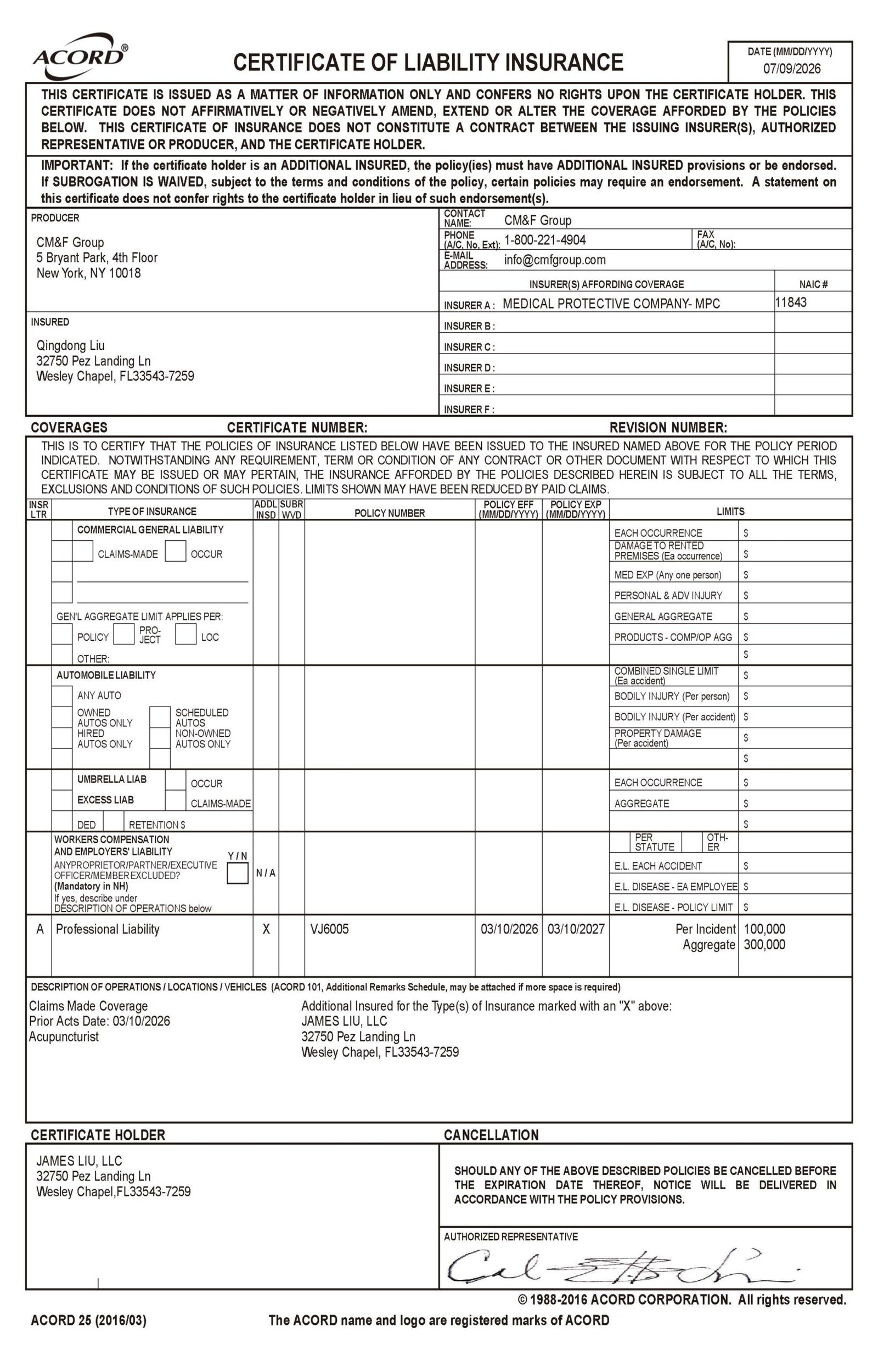
Q8. Does Dr. Qingdong Liu and Holistic Acupuncture & Herbal Care carry professional liability insurance?
Yes. Please view our Certificate of Liability Insurance.
Q9. After acupuncture, why did my low back pain improve, while the pain shifted to my leg and became worse the next day, and my previously numb, cold left foot began to feel warm?
The phenomenon where “waist pain decreases, leg pain increases, and the foot turns warm” is a classic manifestation in clinical acupuncture. It is often referred to as a “De-Qi response” (arrival of Qi) or a “nerve irritation effect.” This is usually a positive sign indicating that the condition is improving and blood circulation is moving downward.
1. Why Did the Foot Turn Warm? (The Core Positive Sign)
• Relief of Vascular Spasms and Restored Blood Flow: When a herniated disc compresses a nerve, it often reflexively causes blood vessels in the lower limb to constrict, making the patient’s foot feel constantly cold.
• Downward Flow of Qi and Blood: The acupuncture treatment has successfully cleared the blockages in the meridians around the lower back and sacrum (such as the Bladder and Gallbladder meridians). This relieved the local compression on nerves and blood vessels. As blood flow and “Qi” successfully reached the end of the limb, the cold foot began to warm up. This proves that the acupuncture has achieved a substantial therapeutic effect.
2. Why Did the Back Pain Decrease While the Leg Pain Increased?
This shifting and intensifying of pain can be explained from clinical acupuncture perspectives:
• “Pathogen Expulsion” and Nerve Awakening:
o When a severely blocked meridian is opened by acupuncture, the accumulated cold-dampness or blood stasis in the lower back begins to disperse downward.
o Previously, due to a severe lack of blood flow, the nerve may have been numb or its conduction weakened. Now that blood flow is rushing back in, the nerve’s sensitivity increases, temporarily causing sharper pain than before. This is often a normal process where the disease moves from the deep layers to the surface, and from the top downward.
3. What Does the Patient Need to Do Now?
This situation is not uncommon during the initial stages of acupuncture (especially within the first 1 to 3 sessions) and there is no need to panic. However, because the pain has intensified, the next steps must be handled with care:
1). Strict Bed Rest:
The patient is currently in an acute phase of nerve irritation. They should immediately rest flat in bed (a firm mattress with a soft topper is ideal) and must avoid twisting the waist, bending over to lift heavy objects, or sitting for prolonged periods.
2). Closely Monitor Symptoms:
o Signs of Improvement: If the leg pain remains intense over the next 1–2 days but the foot stays warm, or if the pain begins to retreat upward (moving from the calf back up to the thigh, and then back to the lower back—known medically as “centralization”), the patient is thoroughly recovering.
o Red Flag Warning Signs (Seek Emergency Care Immediately): If the worsening leg pain is accompanied by a sudden onset of incontinence (loss of bowel or bladder control), numbness around the groin/anus (Cauda Equina Syndrome), or an inability to lift the toes/foot (foot drop) and sudden lower limb weakness, they must go to the emergency room immediately.